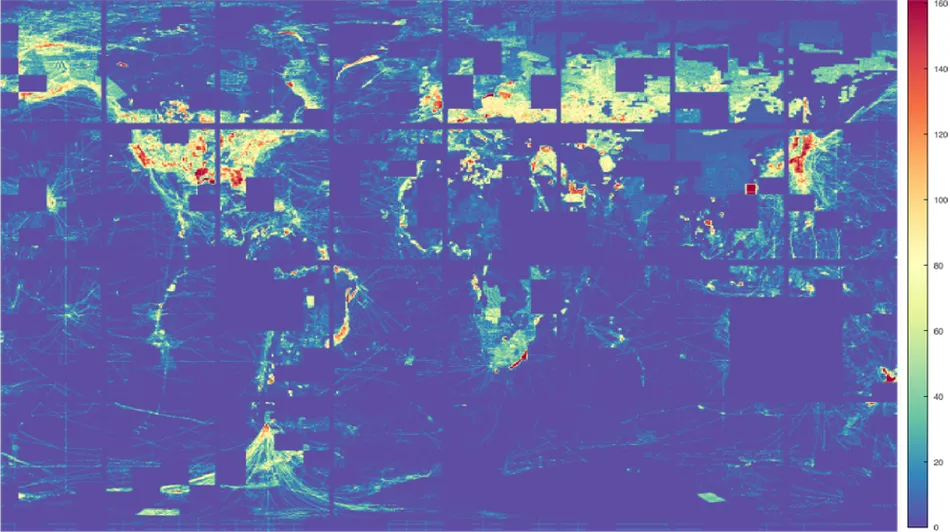
Demonstrate the possibility of producing high-resolution gravity maps on a global scale with consistently reliable quality at reduced cost and effort.
Challenge
Current gravity mapping techniques are financially inefficient and produce inconsistent data quality. Geoscience research needs a global scale gravity map with consistent resolution and reliable quality.
Approach
- Artificial intelligence (AI) enables deep feature mapping that learns nonlinear relationships between endpoints of interest and complex key inputs.
- For AI-driven gravity maps, deep neural networks can learn the relationship between critical geophysical variables.
Impact
- Uncovering complex relationships between various geological, topological, and density patterns
- High-resolution gravity maps to support accurate inertial navigation systems
- Early detection of earthquake activity for natural disaster preparedness
- High temporal gravity anomaly monitoring